
ItalianoEnglish
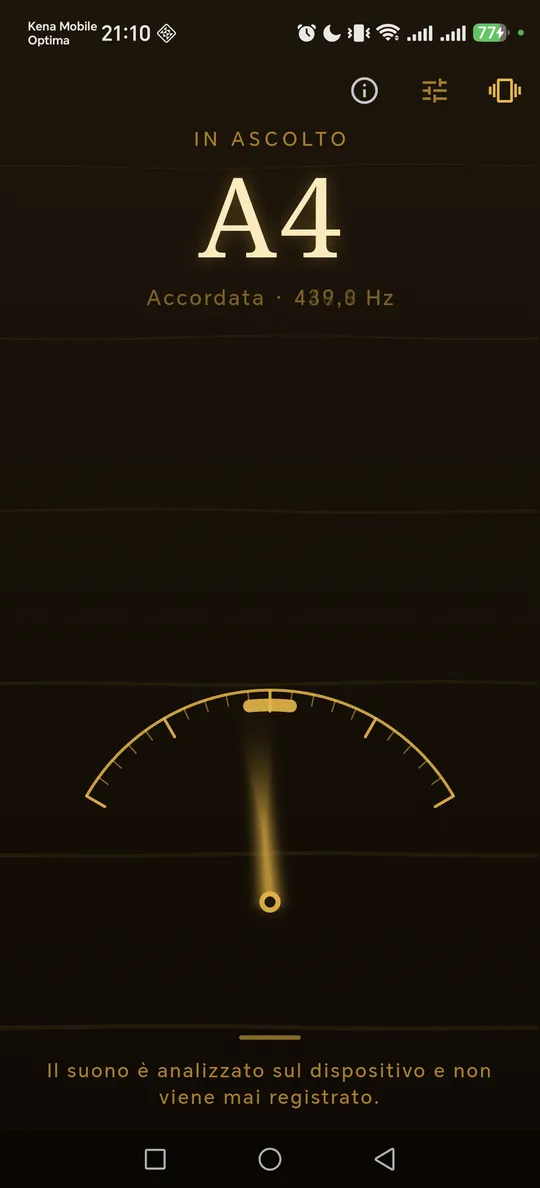
It opens listening. No instrument to pick, no string to select, no tutorial: play a note and the app tells you which one, and how flat or sharp. The needle moves with the string, with no easing in between.
Inside five cents the measurement becomes a word. 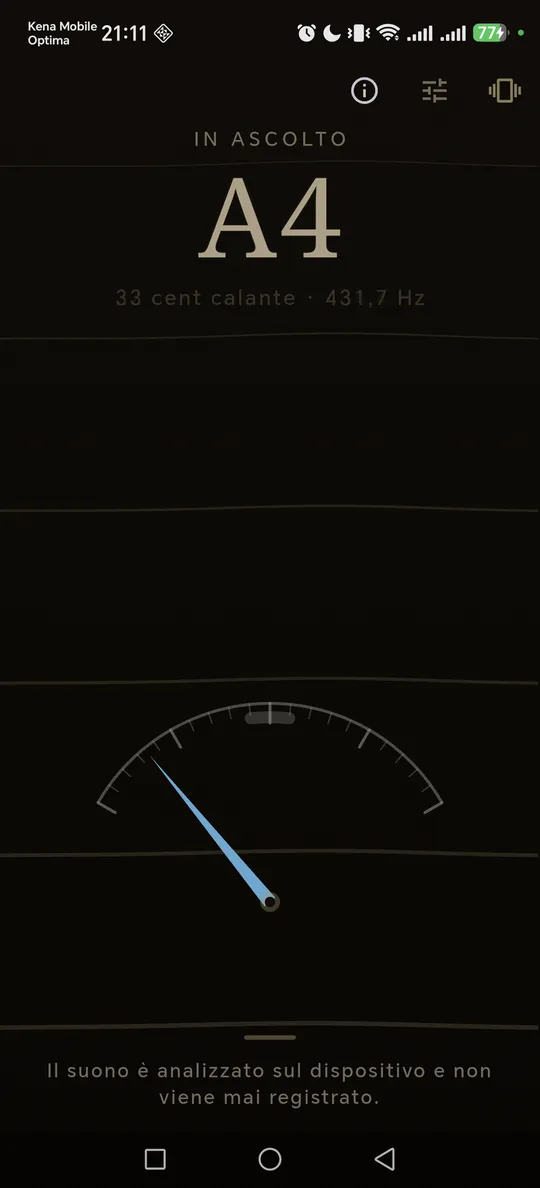
The side and the colour say the same thing twice. 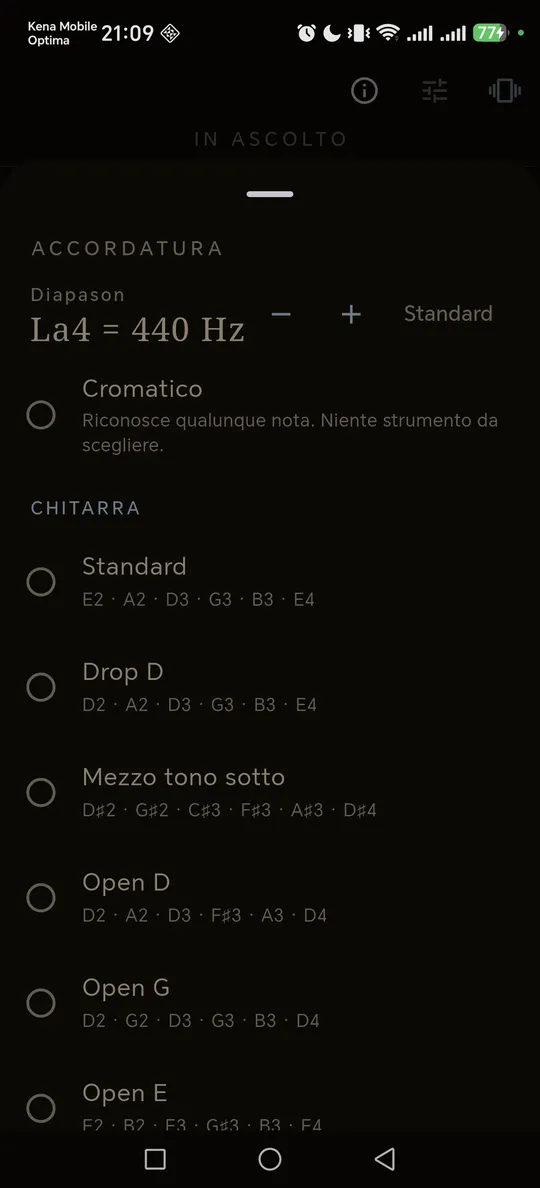
Guitar, bass, strings — and a 415 to 466 Hz reference.
What it does
- Note, octave and frequency. "A4 · 440.0 Hz": what you need to tune, and what you need to understand.
- Cents, with a direction. Left and blue when flat, right and rose when sharp — the side and the colour say the same thing twice, so you can read it out of the corner of your eye.
- Inside five cents the measurement becomes a word. The needle enters the gate and "In tune" appears: that is the answer you opened the app for.
- Two beats when the string is right, one short tick when a new one is heard: you tune with your eyes on the peg, not on the screen.
- The strings drawn on the background vibrate with what the microphone hears. It is the only honest sign that the app is really listening.
- In English and Italian, following the phone's language.
Reference pitch and tunings, for whoever needs them
- Reference from 415 to 466 Hz: baroque, 432, or an orchestra pulling at 442.
- Guitar standard, drop D, half step down, open D, open G, open E, DADGAD.
- Bass in 4 and 5 strings, ukulele, violin, viola, cello, mandolin, banjo, Irish bouzouki (GDAD and ADAD).
- With a tuning chosen the cents change reference: they are measured against the string you are aiming at rather than the nearest semitone. On a badly flat string those are two different answers, and only one of them is the one you want.
Until you touch anything it stays chromatic at 440 Hz, which is what nine times out of ten is needed.
Why a low E does not become the E below
Note detection uses the YIN algorithm, which works on the period of the wave rather than the peak of the spectrum: that is why a guitar's low E is not reported as the E an octave below, the classic tuner mistake. The maths is checked by automated tests against synthesised tones before every release.
Your data stays yours
Tuner does not record: the sound is analysed in the phone's memory and thrown away, and no file is ever written. No account, no location, no server of ours. Three permissions — the microphone to hear the string, Internet for the ads, vibration for the feedback.
How it is paid for
A banner at the bottom, away from the controls, and an occasional full-screen ad only after the string is where you wanted it. No subscription, no tuning held hostage.