
ItalianoEnglish
A sundial on your phone: the dial for where you are, the shadow where it falls right now, and the time the Sun keeps.
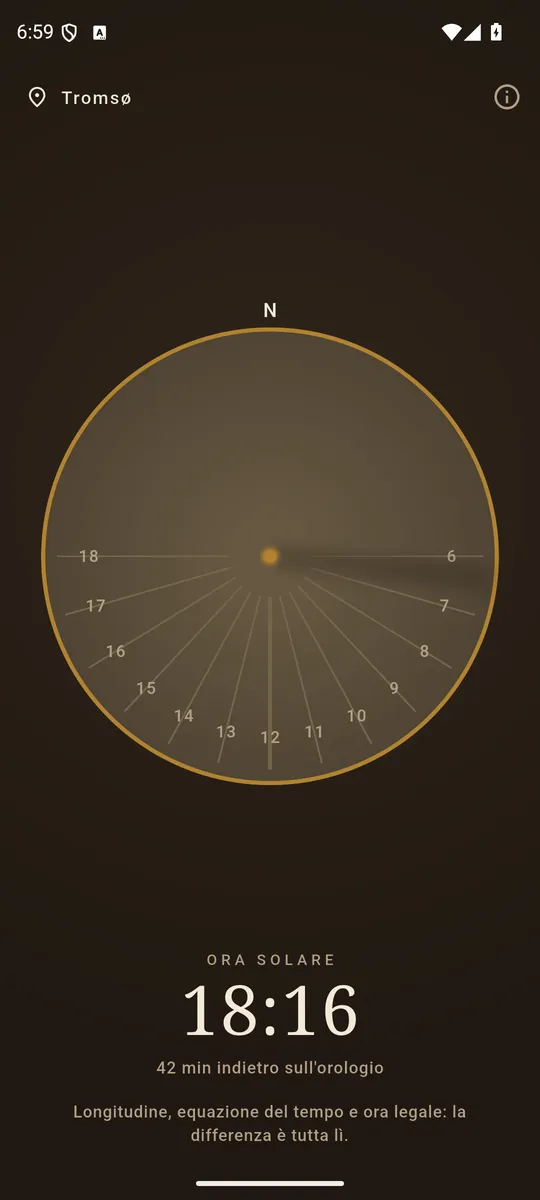
The hour lines depend on the latitude: the dial is yours. 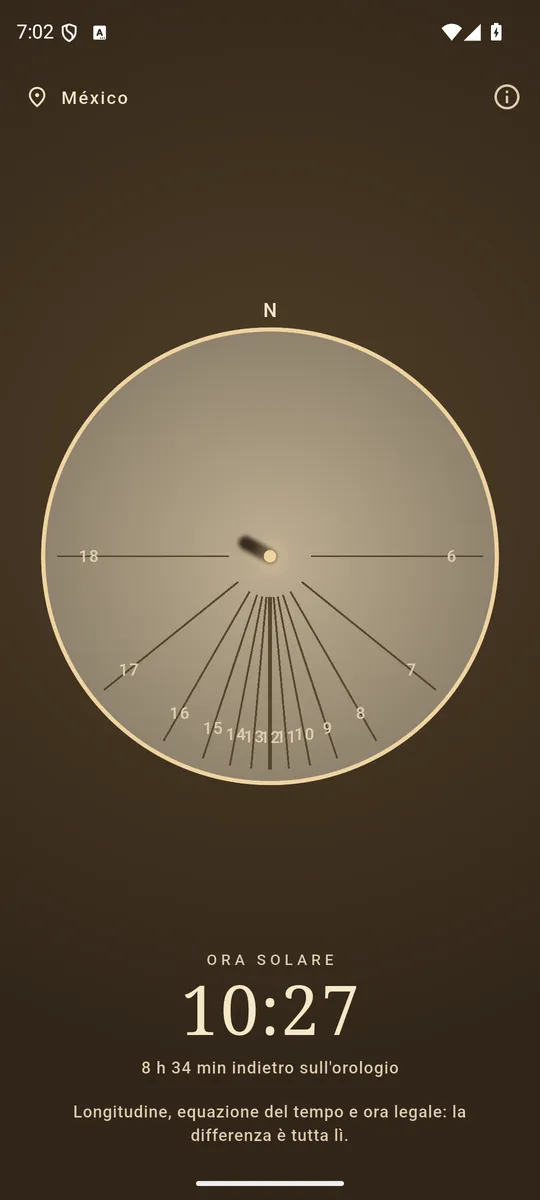
Long and soft at dawn, short and hard at noon. 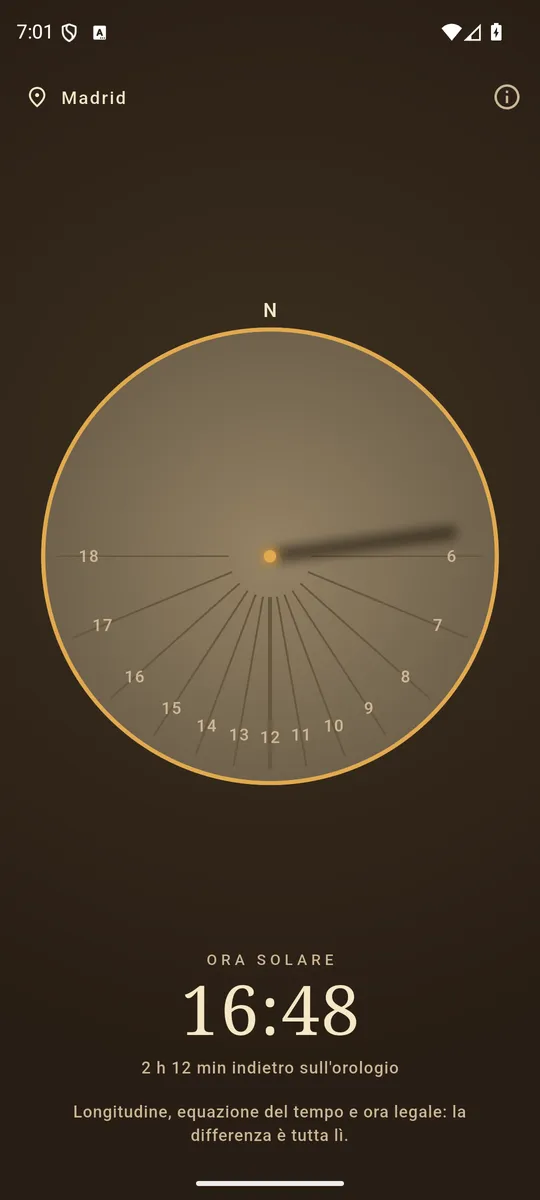
Longitude, equation of time, summer time: why it does not agree.
The dial is yours
The hour lines of a horizontal dial are not evenly spaced, and how uneven they are depends on the latitude: at the equator they collapse onto noon — a horizontal dial does not work there at all — and towards the pole they open out to a clean fifteen degrees an hour. The app redraws the plate for the place you are in, and that is the thing worth seeing rather than reading.
The shadow falls away from the Sun, as long as the cotangent of its altitude: enormous and soft at dawn, short and hard at noon. At night there is none, and the app says so instead of drawing a fake one.
Why it disagrees with your phone
Three reasons, all of them real:
- Longitude. A time zone is an hour wide: away from its central meridian the Sun is early or late by up to half an hour.
- The equation of time. The Sun is not a uniform clock: it runs up to a quarter of an hour fast or slow over the year.
- Summer time. A whole hour of it.
The app shows the difference rather than hiding it, because it is the first thing anybody asks a sundial — and because a sundial that always agreed with the clock would be a badly drawn clock.
Your data stays yours
Sundial asks for coarse location and nothing else: a kilometre of longitude is four seconds of solar time. No background location, no account, no servers: your position never leaves the phone. Everything is computed on the device, and the network is needed only for the ads. If you would rather not give a position, a list of cities is bundled with the app.
How it is paid for
One banner anchored at the bottom, and that is all: no subscription, no feature held hostage.